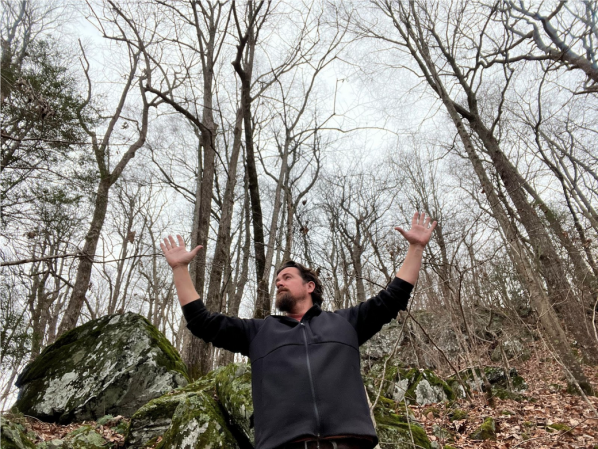
The youngest son of two academics, Dr. Ben Morris was all but destined to become one himself. Considered a solid student by his teachers, his favorite subjects were English, Spanish and Social Studies. He was also an athlete and played for the school's golf team. Although Morris was no Tiger Woods (neither on nor off the green thankfully) he was—and is still—pretty mean with an 8-iron. After graduating high school in 2001, Morris took a three-year academic hiatus, during which time he clerked at Video USA in Pennsylvania, and worked at an assisted living home on Lake Erie, where he’d assist residents in completing daily activities like getting dressed, taking baths, exercising, eating meals, and taking medications. Morris said his favorite part of the job was sitting beside residents, talking about their past and present, while gazing out at the lake. He still reflects on those moments by the lake and feels a deep sense of gratitude even now, some 20 years later.
Though unrelated to his eventual profession, his early work was not wasted. In fact, these jobs inspired some of his first stories during undergrad. Returning from his academic exile, Morris earned a B.F.A in Creative Writing from Penn State Behrend, followed by an M.F.A in Creative Writing from University of Nevada, Las Vegas, and a P.H.D in English from the University of North Dakota. Morris primarily writes fiction and has several published pieces. Among his favorites are “Sixteen Mile Flood,” his first publication in a reputable literary journal, and “Returning Trains,” a political poem about oil tankers.
Most recently, his published short story “The Cages,” analyzes societies' many stereotypes and notions of masculinity. “The Cages,” which is part of a larger work in progress, tells the story of a father video-recording his son struggling to hit baseballs in a batting cage. While filming, the father questions how to support his son, feeling like a failure because he even has to ask himself the question. Meanwhile, the two stand in awe of a boy a few cages over who is hitting absolute dingers out of the cage while his own father turns a blind eye.
“The Cages” was inspired by a moment when Morris was casually throwing the baseball with his own son, the youngest of his two children, when his son hit a piss-missile straight at his face. Reflexively, Morris took a “weird little hop” out of the way, which bowled his son over in a fit of ruthless laughter. Admittedly an unmasculine and slightly humiliating move, it made him think of all of the emotions involved in father and son interactions. You can learn more about the craft involved in writing “The Cages”—(and sucking his thumb for water)—below.
EA: If you could have a liquid come out of each finger on one of your hands, what would the five liquids be? And what hand would it be?
BM: Five different liquids, one for each finger. Is this being published anywhere [Says laughing]. Well, one would be water, big water drinker. I'll start with the boring one first. And that would be, I think, my thumb. And just because it's the closest one, it's the most accessible, it's the one I need the most, right?
EA: Would you suck your thumb?
BM: I think so. Probably in the privacy of my own office, though, I don't know that I'd walk around like this[puts thumb in mouth] unless it's a universally understood thing that I'm doing this.
EA: It's just you.
BM: Good to know the rules. Yeah, that's a private thing that I do, maybe in front of my family. Otherwise, I'm probably by myself. The second liquid would probably be coffee. You know, if I want to do a half and half, like my middle finger could be half and half, we'll just, we'll just go with the basics. So, yeah, water. Thumb. The pointer is going to be coffee.
Finger three would be maybe a nice pale ale, something like that, maybe something local
palette painter or Longleaf IPA from AnB, you know, just promote local. Finger four, I would do milk. I do enjoy a glass of skim milk from time to time, usually with a particular bite of food, you know, whether it's a cookie or a piece of pie or cake, or something like that. And then finger five, I've got to go bullet bourbon. And I think the pinky would be the best one, right? Because hopefully it would release the least amount, and it's the hardest to get to, and it's the one I probably need the least, yeah, as a person, but one I want nonetheless.
EA: Solid, that’s a respectable five.
EA: What is the origin story of you becoming a writer?
BM: So I started in high school writing a poem about protesting American values. And of course, you know every line was rhyming, and I think I rhymed sedition with petition, but the teacher encouraged me, right? And I think that's usually what a lot of our stories begin with, is having some awesome teacher who says, You know what this isn't bad, or, you know what this is good? You should pursue this. You know, keep writing. And then eventually I got to college, and I had another one of those teachers, Tom Noy, I have a couple of his books on my shelf. He was my my mentor, my thesis advisor, and just an all around wonderful guy, which I know played a part in me wanting to be a writer is not just the craft, but also just sort of the persona that a lot of the good ones seem to have, that they're easygoing, they're they're open, they're kind, they're not all like that, of course, right? I can think of many that aren't that I've met that are, you know, pretty big up there, but I really liked Tom a lot, and he encouraged my fiction writing, again, got some good feedback, won an award or two at the college level, and just sort of got enough of a ball rolling to kind of keep going with it and then finishing with a BFA. Didn't really know what to do with that, but try and roll it into an MFA. And then got surrounded by more, more writers, more like minded people, but we were all working on something different, and that was really cool. So I love that atmosphere. So then I'm even just like, on a personal level, I really enjoy writing mostly fiction, but poetry as well, and I get a lot of personal satisfaction from it. My writing doesn't reach a lot of big audiences, so a lot of it is done out of the love and appreciation for it. I'm not the kind of writer that makes money from it at all, and that's okay, I like reaching little pockets of people and boring my kids with my ideas is a favorite pastime of mine now.
EA: Was there a moment when you started to consider yourself a writer?
BM: Ooh, that's dangerous, right? Because you never want to come out and declare it. At least we didn't where I was from. Probably grad school I think there I felt more safe to do it. But yeah, I didn't know when or how to declare that. Like, did you have to have a publication? Did you have to have a book? Did you have to give a reading out loud, where people came and gathered? I would say grad school was when I was confident in calling myself a writer. Do I now? Not often. You know there are days when I don't feel like a writer, that's for sure. And then there are good days when I went, yes, I got this. I am a writer.
EA: Can you tell me some about the cages?
BM: So that was a piece that got published recently by flash fiction magazine, which is the medium that I've been writing a lot in lately, in part, just for my own attention span, and then also, I think it's, unfortunately, a good way to be read, I think in a lot of circles these days, just with how busy everybody is, how fast everything moves, I think flash fiction is a really nice, quickly digestible form, but it's part of a larger piece that I'm working on, a larger manuscript about different notions of masculinity and the cages in particular, is with a father and son, the son practicing his batting in the batting cages in a nearby town, and the father not really knowing how to support the son, feeling less than because he doesn't know how to support the Son. The Son is not very good, and they both sort of are in awe of a boy nearby who's really quite good. And ironically, the dad of that boy is not paying attention at all. So yeah, it's something I've been working on for a little bit, and I was happy that it found a home.
EA: What inspired you to write it?
BM: So there was this moment when I was pitching to my own son. It wasn't in a batting cage but it was in a netted batting cage. And I was behind one of those pitching stands, and I threw the ball, he slugged it, smashed it right back at me, and I did this weird little hop, which was like, so unmasculine, right? [demonstrates the hop]. Yeah, I kind of jumped just as a reflex, and it made him laugh. He was laughing at my reaction. And that moment was sort of humiliating, but also very human, and that just sort of got me thinking about all the different kinds of emotions that are involved with those types of interactions. And of course, he wanted me to film him batting, which the character in the cages wants his dad to film everything, right? So maybe they can post it. But yeah, that was sort of the impetus for that story.
EA: That's awesome. Is there a specific response you want in readers after they read the cages?
BM: I'm hoping that they have a response. I hope it doesn't leave them indifferent. I hope it doesn't leave them sort of shrugging. I would like them to think about any relatable moment that they've had like that. Not necessarily with baseball or even with a child, but just that idea of performance and support, and feeling are you doing the right things for this person, the way that they need them, or the way that they want them? I think there's some possible connection there that that people can maybe latch on to.
EA: That's good. If you could have dinner with one writer, dead or alive, and interrogate them about their process. Who would it be? And what would you want to know?
BM: Flannery O'Connor. She's got this great story, “Good Country People” where this traveling salesman steals the wooden leg of this character who's kind of young ish, maybe a teenage girl, so she can't essentially move from the barn where he lured her. And I remember reading about this story as an undergrad in that Flannery O'Connor, when she wrote that ending, she had to get up and walk around the room, because it startled her and surprised her so much that she would write that. That that came from her mind, right? And so I guess I would want to sit down with her and ask her how often was she able to do that? Was that a requirement for her? Did that start to symbolize that I've gone to the right place in this story? That's something that I constantly struggle with. Am I going in the right place with this story? And they often say no surprise in the writer, no surprise in the reader. And maybe that came from a Flannery O'Connor anecdote, I'm not sure, but that's always something I've latched on to, and I've tried to surprise myself. So did she see that as sort of a key to a story's success? It'll be something I'd want to know.
EA: What is the most interesting thing about you, or do you have any hidden talents–apart from writing?
BM: That seems like a trap question, what is the most interesting thing about me? I'm a pretty good golfer, but I don't play much. It's of course expensive, and it takes a lot of time, and I have two kids, and I can't rationalize going out for four hours, 4 or 5 hours, playing 18 holes, waiting, being away from my family. It's really bizarre, it's something I've struggled with these last couple years. And even my partner looks at me like, “why don't you ever golf?” I was like, I just, I don't know, but I enjoy it, and it is sort of a hidden talent I played for my high school.
But, yeah, I just, I just don't do it.
EA: Do you have a favorite club in particular?
BM: This probably says something about me. I really like an 8-iron.
EA: Same! When you hit a good 8-iron just right, there's nothing better!
BM: Yeah! I think you have to exert a certain amount of force, but also control. You can't just haul off, like it takes a certain amount of force. Usually it's part of the short game, like 140, 150 yards out from the hole, it can be sort of make or break, you know on that approach shot. There is little else out there that feels as sweet as a nice 8-iron off the tee for sure.
EA: What were you like as a student? Do you think your professors would recognize who you are now as a student and teacher?
BM: I think most of them probably would, I've been relatively consistent in my desire to be in academia, in the college setting. I took 3 years off after high school, and once I realized that I enjoyed that atmosphere, I bet they could probably see something, like, oh, he's, he's going to be sticking with this, right? And then again, I think that's what led from the BFA to the MFA to a PhD. I really enjoyed the atmosphere and the energy. I still keep in touch with Tom Noy. I keep in touch with a couple professors from grad school, and, yeah, I don't think any of them are really shocked that I'm here.
EA: What made you want to come back after those 3 off years?
BM: Yeah, basically joining the workforce and where I was in the early 2000s I had a great job as a video store clerk at Video USA, in Pennsylvania, favorite job ever until this. And then that place closed, and I had to move on. And the type of work that I was doing, I knew was not going to be sustainable, and I later found out that a lot of those jobs would inform a lot of the work that I did, especially as an undergrad. So I would write about working at a video store. I would write about working for an assisted living home, which actually, that definitely gave me more meaning than working at a video store. But I ended up turning all those jobs into early stories. I kind of liked how that developed. Both my parents were academics as well. I'm sure that played a part. Seeing them teach was really cool as well. And just the energy, and how their students responded to them was pretty inspiring as well, not so much as a writer, but as an instructor.
EA: What would you say is the most dangerous thing about studying English, what can it do to you that you can't undo?
BM: Danger, I've never thought about it like that. I've always seen it as a sort of opening, not an escape, but as a place of freedom, as a place of imagination and possibility. As whimsical as all that sounds, I've never associated it with danger. I guess it could provide you with a false sense of possibility. Is it possible that some of those could turn back in on themselves, like if you read about the capability of humanity and the endurance of spirit, and if you don't encounter that experience in your own life, would that be a further letdown? I don't know. Maybe this is a Friday afternoon meditation. I don't know. I'd like to think there isn't a danger in that. I know a lot of people say there's danger in being an English major just because of the job market, but I don't think that's really what you're referring to. I don't know what you're gonna do with that answer.
EA: Can you finish this sentence for me? Students should study English at App State because of blank, but don't give me the catalog answer.
BM: Students should study English at App State because of the possibilities, I'll leave it at that.
EA: All right, I have a very serious question for you. Do you believe that a song bird sings the song of its own life, or does it merely mirror the tune it yearns to follow?
BM: I think this will say a lot about me as an individual how I answer this. I think it's a mirror.
I think it is gathering what it has heard before, even maybe in utero, and singing back to its influences, back to the sort of gathered songs that it has heard, right? Even subconsciously.
By Ethan Atwood
Photo of Ben Morris in the woods