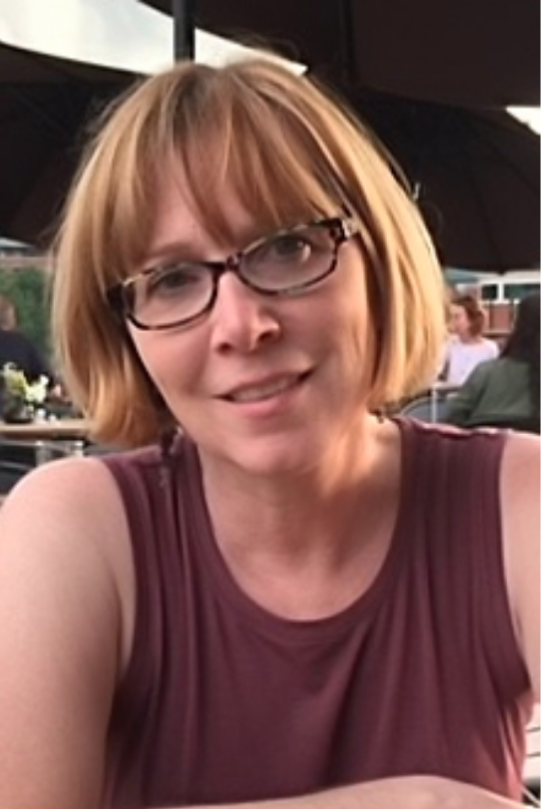
Alison Gulley always knew she wanted to be a medievalist, so when App State’s position opened, it felt less like an opportunity and more like a hard-won arrival, and she brought with her a contagious enthusiasm for a corner of literary history most students don’t realize they want to study until they meet Dr. Gulley.
Her office reflects the breadth of her knowledge and passion for the field. Her medieval bona fides are real and impressive. Her education took her from Chapel Hill to the British Museum, where she held the original Beowulf manuscript, a privilege extended to very few people in the world. So it’s no surprise that when forced to choose between Beowulf and The Canterbury Tales, the epic poem wins.
Medieval texts and journals fill every inch of space in her office and her personal reading life requires an at-home library just as large. She’s currently working through The American Queen by Vanessa Miller, a North Carolina historical fiction, and several mysteries, which are where her reading heart really lives. Not the Sherlock Holmes kind mind you (she was quick to clarify that). No, her allegiance belongs to the likes of Elly Griffiths etc., a British author whose archaeological obsessions Gulley finds far more compelling than the slapstick shenanigans of 221B Baker Street.
Outside the classroom, Gulley champions student clubs—especially book clubs—and envisions one where faculty and students read together sans grades. She believes in broad coverage of English history, but also believes some of the best learning happens when the stakes are low but the conversation is high. Oh, and the outdoors—she’s a big fan, and if she’s not teaching or holding office hours, you can probably find her on a backcountry trail with her family.
Alex Gluth (AG): Everyone has been dying to know, including myself; Canterbury Tales or Beowulf? What do we like more?
Alison Gulley (Dr. G): Oh gosh, that’s a hard one! And I’m teaching both right now. Um, maybe I’m leading toward Beowulf these days. I'm teaching a grad class, “Manuscript to Screen”, and we're trying to get to the bottom of why people keep reading Beowulf. Why do they keep making movies and comic books and rock operas, and those things?
AG: Rock operas?
Dr. G: Yeah, it’s written by Julie Taymor. She did “The Lion King on Broadway”.
AG: Now this one may be tricky, but give us the top three "Should be a Netflix series" of Medieval Literature. Which ones and why?
Dr G: Okay, I’m gonna go with King of Tars because it's very topical and it's about a Christian princess and it just made its way into the Norton Anthology of Literature.
AG: Do you know roughly when that was written?
Dr. G: 13th century.
AG: Gotcha, and what about the two others?
Dr. G: Two others, gosh! That's probably the top one. I think we could do a werewolf story! Lets go with Bisclavret, that one is pretty well known. That would be a great mini-series. Okay here’s one that could be educational, there could be one on all the virgin martyrs. Each episode could feature a different virgin martyr, and I think there's actually a series out there about saints, but those are my three.
AG: very cool, any martyr in particular who would make for a good episode, or you teach in your classes?
Dr. G: Well, there's a set of Roman virgin martyrs, but I think Agnes is interesting. There's an evil emperor throws her in a brothel where she's supposed to get corrupted, I don't really understand what his thought process was there. And all of these are protected by God somehow.
AG: Interesting, I didn’t know about that. Those are really good, I’m trying to think of what I learned in my literature classes and these are so unique, I hadn’t heard of them before. Outside of the Medieval period, if you could visit any past time period, where would you want to visit?
Dr. G: This sounds very colonialist of me! [laughs]
AG: No judgement!
Dr. G: My husband is a Middle East specialist in Political Science and we always thought it would be interesting to visit the Middle East in the late 19th and early 20th century, before it was well known to the West. That was the time of orientalism and colonialism. But I just think it would be interesting to visit there before it opens to the West.
AG: To see the difference?
Dr. G: Yeah!
AG: How did you come to teach at App State?
Dr. G: So I did my doctorate at Chapel Hill. And then- do you want my whole roundabout way?
AG: Absolutely!
Dr. G: My husband finished first, got a job in Virginia, so I moved up with him. Then was up there for three years. finished my dissertation, got a job at Lees McRae. He got a job at App and then five years after that, the medievalist here retired and the miracle was that I got the job! You’ve probably heard that it's hard to find two tenured positions together. So when Kurt got the job here and I could commute up to Lees McRae, we thought we already hit the Holy Grail. Then it got better and I came here and I love it!
AG: And does your husband still teach here? You said a Middle East specialist?
Dr. G: Yeah he's in the political science department!
AG: You teach medieval and British literature (generally). What inspired your love for this genre of literature? Was it movies or books or travel?
Dr. G: It’s completely because Chapel Hill at that time required every grad student in the English department to take two semesters of Old English. And I thought- I had written my thesis on DH Laurence, and I kinda thought I would do modernism and women studies, but by having to take those old English courses, I discovered something I didn;t know anything about and I loved it!
AG: Do they offer Old English studies here at App?
Dr. G: No, but I sometimes do independent studies, I’m doing one this semester.
AG: Which of the world's archives or relics you've visited or held and studied ranks as the best in your mind and why?
Dr. G: Back to Beowulf, I had a NEH fellowship to work at the British library one summer, and it was a seminar so there were other NEH fellows. We studied the Beowulf manuscript which is usually kept very protected of course, but they brought it out for us to work with.
AG: Woah, okay! Did you get to hold it or was it off limits?
Dr. G: We had to wear gloves! When I take students here to look at our manuscript leaves, we always say touch them because the oils in your hands help protect the pages. For something as fragile as the Beowulf manuscript, which was heavily damaged in a fire, it’s a little more fragile than other manuscripts.
AG: And to all students in the English department and deciding their concentration, why should they take your class; what relevance does Mid/World Lit have on contemporary student lives?
Dr. G: That’s a good question! So I also teach History of the English language and I am a firm believer that students need to have broad coverage of our whole area and know something about the English language and literature. With the history of the language in particular, it's required of our English Ed students, and I feel like we're sending them out into a battleground. The kind of information you learn and study in the English language prepares you.
AG: Definitely! I like that your answer was broader than, “I’m a cool professor, I have the best classes!” It does pertain to a broader spectrum!
Dr. G: Then there’s people like Thomas Jefferson who wanted the American Seal to feature the two brothers who were supposed to have founded Britain because they were the source of modern democracy (which was not true either).
AG: Did we learn they were not the source of democracy after this proposal, or did he know and just run with it?
Dr. G: I don’t think he knew that, I think it was just people romanticizing the past. He actually proposed that everybody should learn old English and he had planned to write an old English grammar book but died before he could do that.
AG: I did not know that, very interesting! Don’t feel bad for overexplaining, I’m getting a history lesson out of this!
Dr. G: I think a lot of people look at medieval literature and think it's just old stuff, but it's got real relevance to what we do today and how we understand ourselves.
AG: If you put text side by side, you’ll find comparisons and commonalities.
Dr. G: Yeah, definitely!
AG: Outside of teaching, how do you spend an ideal weekend?
Dr. G: I love to hike, so a good hike. Going out with my husband, what else? Yoga, a hike, going out on a date, spending time with my kids. I’ve got grandchildren, one’s in college, one just graduated, so if they’re home, that’s nice!
AG: Are you a big reader!
Dr. G: Oh yes!
AG: Any specific genre?
Dr. G: I love mysteries, British mysteries.
AG: Okay, am I safe to assume Sherlock Holmes?
Dr. G: Actually no, I don’t like Sherlock Holmes. PD James is someone I like a lot. Lately I've loved Ellie Griffiths. She’s great, it's about an academic archeologist who solves crimes. The professor is Ruth Gallow, she’s got like thirteen of them. If left to my own devices, I would only read mysteries. Now I’m in two book clubs and it's making me read things I wouldn’t normally. A Tale for the Time Being, it's a woman who finds a Hello Kitty lunchbox washed up on the Vancouver shore. She thinks it's from a tsunami, with diaries and letters in Japanese. She starts translating them, and the story goes back between a sixteen year old girl and the woman translating them. I was disappointed in my bookclub, only three of us read it. Then in my other bookclub- I used to be a girl scout leader, were you a girl scout?
AG: No, but I always wanted to get Girl Scout cookies!
Dr. G: In this other book club I’m in, we just read The American Queen and it's a bit of North Carolina history I’d never heard of. It's about freed slaves who established a community on the North Carolina border. It was a commune where they pooled all their resources and after about forty years it broke up. I poked around a little bit, and then I found a bit online on an article. Just last month, a guy from Hendersonville gave a talk in Asheville.
AG: Ahh, and you mentioned two bookclubs, what are those?
Dr. G: One was started by a friend of mine who is in Communication Disorders, so it has a lot of university people, but it's expanded. And then the other one is women who were involved in Girl Scouts (The Unapologetic Page Turners). I started that one, I just missed seeing them a lot. Are you in a bookclub?
AG: I am not, I should be though.
Dr. G: We should have one in the department. For years, people would ask me, and I’d always say “no, my job, we read and we talk about what we read”, but I started both of these in the last couple years and I love them!
AG: If different professors came in with certain genres or their concentrations, that could bring in diversity!
Dr. G: You should do that and have a common reading for the English department
AG: Yeah, and someone might not be big in one area, but love another, so that way people can still be involved
Dr. G: You should suggest that to somebody!
AG: Thank you, maybe I will. But that’s all of the questions I have for you today.
Dr. G: This was really fun and it was very nice meeting you!
AG: Of course, it was nice meeting you as well! Thank you!
By Alex Gluth
Photo of Alison Gulley