You can usually find Charlotte Isenberg hunched over a desk, writing under the soft glow of a lamp. Whether she’s breaking down a Shakespearian sonnet or writing an article advocating for social justice, for Isenberg, an App State major in Rhetoric and Technical Writing (minor, Political Science), words are more than inspiration; they’re as essential to her as air.
Originally a Physics major with a curiosity for Los Alamos, home of the first nuclear bomb, Charlotte changed majors when she realized that she preferred to see the world through words, not numerical formulas. Perhaps her switch to English was inevitable. After all, she performed her first poem “Books” for the 3rd-grade talent pageant show. Though the physical word intrigued her, opportunities to shape the world through rhetoric and impact the lives of those living in unjust circumstances intrigued her more.
As President of the Student American Indian Movement, she keeps her own tribe, The Cherokee Nation, close to heart while advocating for others. Her advocacy work includes political organizing and attending protests, as well as helping with food drives. She particularly enjoys working in the garden and on cultural preservation programs by receiving teachings from her Elders of the Cherokee Nation. If it seems like Isenberg is everywhere all at once, it’s because she kinda is. In addition to her Presidency with the SAI, Isenberg also participates in the Abortion Doula Collective, a student-focused abortion-education and advocacy organization that aids those who reach out directly. She is an example of the student becoming the master though when asked if this phrase resonated, she was quick to reply that the learning was never over. “Aren’t we lucky?”, she said, a nod to singer Jeff Buckley.
For Isenberg, luck plays only a small role in her success. Hard work accounts for the rest. And it was both her work ethic and writing talent that caught the eye of the editor at The Peel, who invited Isenberg to contribute as a writer and eventually promoted her to Associate Editor. In this position, she helps create poems for the special edition of literature and arts. (Keep an eye out, as this edition will be coming out soon!) With several MFA program applications in the works and a reading at the Western Carolina Literary Festival on the horizon, Isenberg is poised to achieve her dream of becoming a writer who aids those through the power of the written word.
Alex Gluth (AG): You’re in the midst of graduate school applications now. What do you hope to work as?
Charlotte Isenberg (CI): I know I’ll end up doing advocacy writing of some kind, be that with my tribe (Cherokee Nation, capitol in Tahlequah, Oklahoma), local government, or a nonprofit.
AG: Was there a specific moment that confirmed that this degree is the right path for you?
CI: I’ve always been a writer: in my first beauty pageant, third-grade I read an original poem for the talent portion titled Books, and it was about how much I loved books. In elementary school, I was surprisingly good at math, and I got to attend a physics day at the Nascar Hall of Fame in Charlotte. After that, I started telling everyone I would be a scientist. I decided to major in physics after a few visits to Los Alamos, where the first nuclear bomb was formulated. That might sound kind of morbid, but it was really seeing the mesa's beauty alongside the work of the scientists at the national laboratory. A lot of people think nature and science are a dichotomy, but I realized they aren't opposed: it's all physics. It's the study of everything! I used to be a physics major, and I will always love physics, but I walked out of my first PHY class and immediately made my way over to Sanford so I could change my major. I knew I didn’t quite fit in there. I changed majors because I realized I'm more interested in coming up with words, rather than numbers, to describe the world, but I like to think I will always be a scientist in my own way.
AG: Outside of classes, are there any clubs you are involved in? Any hobbies?
CI: I’m President of the Student American Indian Movement, Founder and Lead Organizer of the App State Abortion Doula Collective, Associate Poetry Editor for The Peel, and in my free time I like to roller skate or write poetry.
AG: Is there any medium of writing you enjoy (Creative novel, poetry, essays, rhetoric, etc.)
CI: I enjoy all writing. I know that sounds cheesy, but I really do. I mostly write poems for the same reason I liked solving a good equation: when the pieces fit together perfectly and it makes a sort of song, it’s the best feeling in the world.
AG: If so, what inspires you to do so? Is it something you would hope to pursue?
CI: I’ve applied to a few MFA programs at the request (demand?– haha!) of my mentor Lee Stockdale. I’ve never really considered myself a great poet, but if they’ll have me, I’ll keep pretending.
AG: What is your message to others within the English department, or those who may be deciding on an English major?
CI: There are a million things you can do with an English degree. Don’t let anyone make you feel like it’s a bad career path. I constantly meet people desperate to find someone who both writes well and loves to do it.
AG: What is something you have learned at App (in class or out), that you did not expect?
CI: Leadership is mostly about listening. I used to think being a leader on campus is all pointing and directing, but you really are nothing without the collective knowledge of your people.
AG: What is your motto or a mantra that you find most inspiring? (6 word mantra)
CI: It’s never over—aren’t we lucky? (thanks Jeff Buckley)
AG: You were selected to be mentored by Lee Stockdale through the Gilbert-Chappell Distinguished Poet Program with the North Carolina Poetry Society. What does this mean to you in terms of academia? How did you come across this opportunity, or was it brought to your attention via the mentor?
CI: It’s definitely opened me up to creative writing opportunities, especially since I’ll be doing a reading at Western Carolina’s Literary Festival. I have The Peel to thank for that. I believe it was Ember, our Editor-in-Chief, who I heard about it through.
By Alex Gluth
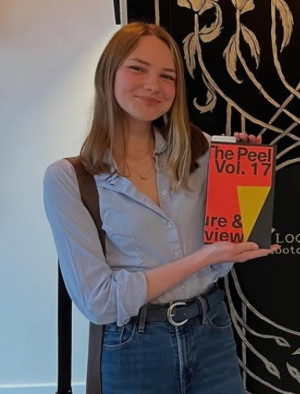
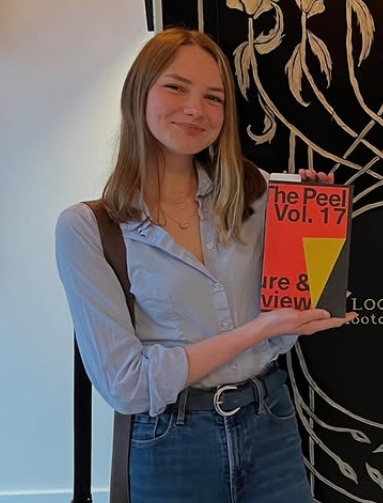
Photo of Charlotte Isenberg holding a copy of magazine titled The Peel