Written by Ethan Atwood
Picture it: the basement with moody lighting, gritty aesthetic, and stereotypical redbrick walls, wherein a male comedian takes the stage and proceeds to tell sexist jokes that land just right with the crowd, the ones nursing IPAs, demolishing buffalo wings, performing the kind of easy, unexamined masculinity that mistakes cruelty for wit. What or rather who remains invisible in these spaces are the flesh and blood folx — the front- and back-of-house workers, the wait staff and cleaning staff and bartenders, women, trans, non-binary people, and any man who doesn’t fit the room — who are served up as fodder but also bear the brunt of such jokes and the toxic culture the aggregate of those jokes produces when a society mistakes sexism for humor.
The sexism Dr. Melissa Stone faced while she tended bar at one such comedy club, might not have been as apparent to her (or throat-punchingly-infuriating), but for two things: she was raised by a vocal feminist social worker of a mother, whose life’s work was and remains aiding domestic violence and sexual assault victims; and the feminist pedagogy to which she was exposed during her masters degree work at UNCW.
But before she went back for that master’s degree, Dr. Stone took a five-year hiatus from academia and worked some eight odd jobs across various industries and trades, sketching out what would become her feminist ethos and enduring the patriarchy
She worked at a local cafe, for a wedding caterer, and at two law offices, (one of which forced her to wear panty hose!), TGI Fridays, Applebee’s, Barnes & Noble, and the aforementioned sleezy comedy club.
Of these odd jobs, her favorite was her role at Barnes & Noble, where she worked in the cafe and the children’s literature section, not least of which because she wasn’t forced to wear pantyhose, or deal with sexist comedians telling bad jokes while pushing IPAs in front of equally sexist audience members, though the 30% discount on books was really the cincher.
Though her bookshelves were the envy of any English or Communication major, her pantry was pitiful because — let’s face it — 30% off books will only take you so far, which meant that her diet during these lean years consisted mostly of the “sad bread” she made with her few pantry staples. Even so, it was a small price to pay for a collection of good literature that rivaled the downtown library.
When she quit the comedy club she went back to UNCW for a masters in English, a degree she’d wanted to pursue as an undergrad but never did because she couldn’t satisfy the naysayers when they inevitably asked but what are you gonna do with an English degree? Now older and wiser, she had an answer to that question and had also decided — more importantly — she didn’t owe that answer to anyone.
Masters in hand, she wondered what would it be like to go all the way. And so she set out to do just that, blending her passion for English, Rhetoric, and Communication into a PhD from the interdisciplinary doctoral program offered at NC State. Broadly speaking, Dr. Stone’s main area of research focus is feminist rhetorics and technical communication,with a focus on reproductive justice. She has published numerous research articles and conference presentations on the subject, the most recent of which (which is also her favorite) is “The Material-Discursive Realities of Mobile Menstruation Tracking Apps in a Post-Roe Society” (2025), which, examines how data collected from menstruation tracking apps could be used to criminalize users following the fall of Roe v. Wade.
Read more below about Dr. Stone and her teaching, research, and her favorite art museum in France.
Transcript
EA: If you were to have one member of App State English faculty paint a life-size portrait of you, who would it be and why?
MS: That’s a really funny question. App State faculty, life-size portrait of me. Oh, man, I don't know. I don’t know if I have an answer to that. I could say generally in life my mom, but she does not work at App State, just because I think she knows me best. She gave me my features. So I don’t know if that is an okay answer. I think my mom would probably do the best if she were artistic, and she does some really cool doodling, so I think she could actually do something with it.
EA: And where would you want to be displayed?
MS: I love art museums, but I also don’t want to be arrogant. I would say the Centre Pompidou in France, which is the modern art museum that does very modern art kinds of things. And I don’t say that to be arrogant, I just say it because it’s literally my favorite museum ever.
EA: I love the humility.
EA: All right, so what's your academic history and credentials that have led to where you are today?
MS: That one I can do. All right. I got my undergraduate degree in Communication Studies, oddly enough for being an English professor, at UNCW in Wilmington, and then I took about five years off in between. I graduated in 2008, which was in the middle of a recession, so there weren’t a lot of jobs, and I worked a whole bunch of odd jobs for five years, but I knew there was something else that I wanted to do, so I eventually went back to UNCW and got my master's degree in English. I originally wanted to be an English major, but I sort of let my parents talk me out of it. The age-old “what are you going to do with an English degree?” is not new for our time. I had to experience that too. So then I was like, you know, I’m finally going to do what I want. I’m going to get my master’s degree in English. And it really paid off. It was a generalist program, so there was literature, there was film, and there was rhetoric and technical writing. And while I kind of entered it thinking I wanted to study Victorian children’s literature — and I still really love it — I got really interested in rhetoric and technical writing, and I just thought that there were some really interesting things about it. It’s not just manual writing. I discovered you can actually treat technical manuals or any kind of technical writing as cultural objects, kind of how we do in literature, and they say something about our culture. They might seem boring on the surface, but they’re not. So that was interesting to me. I loved teaching, and you get a little practice with teaching in your master’s degree. And I thought, you know what? What would it be like to go all the way? I was hesitant and tepid. All my professors told me even back then that it was hard to get a PhD and then become a professor because those jobs are dwindling. So I knew it would be an uphill battle. I knew it would be tough, but I decided to go anyway. I got into a couple of programs in North Carolina and then in Virginia, and I chose NC State in Raleigh. I really liked their program because it’s interdisciplinary — it’s Communication, Rhetoric, and Digital Media, which is a mouthful, but it is a joint effort between the English and the Communication Studies departments — I was like, those are my two degrees. And then there's this very excellent focus on technology, but across a wide span, like old and new, I tend to prefer the old ones. I have always been interested in women’s and gender studies. That was something I focused on in undergrad, where I got a certificate, and in my master’s degree as well, and then it became a whole part of what I did with my PhD, because I got super interested in what technical writing objects actually look like for women’s health. My dissertation ended up being on old technologies about menstruation, like before pads and tampons. Then, of course, some of those modern technologies came into play, along with manuals and ideas about how we construct women through these things and how you grow up, and that sort of thing. And then that led me to this job. So I teach a lot about technical writing generally, but I think my sweet spot is really when I’m doing technical writing about health, particularly when it’s integrated with gender and sexuality.
EA: Awesome. What were some of those odd jobs you had in that five-year period?
MS: Some good ones. Gosh. Well, I’ve worked in the restaurant industry for 17 years. The moment I turned 15, my mom made me get a job to build responsibility, and I was annoyed with it then, and I tell her all the time now that it is one of the best things she ever did for me, because I’m really independent and good at working on my own, which is something you need in academia. It’s not a nine-to-five job, so to get stuff done you have to know how to be self-motivated. And I think getting started with work early really helped. So, long story short, those odd jobs a lot of them were restaurants. A lot of them were really terrible chain restaurants like Applebee’s and TGI Fridays. And some of the best ones were owned by individuals. One of the best ones I ever worked at in Wilmington was Jester’s Cafe, which was owned by a really excellent guy named Jamie Thomasson. Post his retirement from being a social worker, he decided to open this little cafe. And I just thought that he was one of the kindest, most open people in the world, especially because he had worked with people who were battling addiction. He just looked at the world in a really great way. He just wanted to help people, and he loved to do it through food. In addition to college students like me, he hired a lot of people who were working through or post addiction, or had stints in prison, and were trying to reform. I really appreciated his vision. So that was one of my best ones. Some of my worst ones were working for weird law offices for $10 an hour with sexist bosses. Yeah, one of them had a requirement that women in his office had to wear pantyhose, and we’re talking 2009 and 2010. But at the time, it was like, I have student loans to pay. So that was fun.
A favorite, even though it was very corporate, was actually Barnes and Noble. I worked in the cafe and the children’s section. I really loved being surrounded by books. The 30% employee discount on books was great. And I’d often spend all my money on books and then basically only have flour and water in my cabinet, and then I’d have to make a sad bread to eat that week. Meanwhile, student loan companies are saying, “you owe us $1,200 this month,” and that’s all the money I have, and I still have to pay rent. So all of those jobs are what motivated me to get a master’s degree.
EA: How many total jobs did you have in that span?
MS: Let’s see Applebee’s, TGI Fridays, Barnes & Noble, Jester, odd jobbing for catering and weddings, two law firms, I was also a waitress at a comedy cocktail place. So eight.
EA: Can you tell me about the comedy bar?
MS: That started right before I started the master’s degree. It was kind of fun, because it was in this really gritty feeling basement. It felt like a New York City comedy club. There was a brick wall that they performed with in the back. It felt authentic. But not only are you dealing with
sexism from the male bartenders, but you’re dealing with sexism from the men on the stage that are saying really disgusting stuff. And then the clientele is also sexist, because that’s the kind of draw that you get, and because of the guy who owned the place, those were largely the types of comedians he would bring in. I remember there was one comedian, I don’t know why she ended up getting a gig, but she was a lesbian and a feminist, and that was her whole shtick. And this was my favorite night to work, and the audience was just women. It was fabulous. I just couldn’t believe that. But she was the only one, the rest of them were just jokes about women’s bodies or their bitches, or whatever. It was kind of depressing.
EA: What are your main areas of research?
MS: Feminism, obviously. Like I was saying earlier, technical writing and rhetorical ideas about women’s health. Specifically, I do a lot of work with what that looks like through app-based health. Women always use cycle trackers — it’s a big thing, probably since around 2013 when the first couple started to come onto the market. — I’m fascinated by them. But when I’m thinking about women’s health and older technologies, I really love turn-of-the-century menstruation technologies, before the pad was invented. The tampon was actually invented before the pad, but the tampon was not something women were supposed to use because of purity culture. So under all these layers of dresses and things they were wearing, there were these big rubber aprons that would just stop leakage from happening. How uncomfortable and also, how unsanitary. So I’m really fascinated by what it was like to have to manage something that is just so everyday for women. We never talk about it in history or in media. I don’t know how many zombie apocalypse movies or shows just act like women don’t menstruate.
EA: Was there a specific life experience or moment that led you to an interest in these studies?
MS: Getting my period as a girl, with my mom out of town. We were staying with my grandma. It was me and my dad and my sister, she was younger than me. My dad’s a man, and my grandma had gone through menopause. I was just like, who do I talk to? I want my mommy.I think it can be far more scary for lots of women out there, but it was a little traumatizing, and I think it kind of led me here in a weird kind of way.
EA: Which of the many publications you’ve written are you most proud of?
MS: One that just came out in 2025 about menstruation apps and data collection and data surveillance, and what to do in a society post the protection of abortion care. It’s a states’ rights issue now, because when the fall of Roe v. Wade happened, a lot of feminist researchers went on social media platforms and said to delete the data on your apps. Delete your apps, you cannot use these apps anymore. They can be used to criminalize you if they find that you have sought abortion care. The idea there is that someone could take an app that a woman has used, and because you’re putting in the day and time of the beginning and end of your last period, they could use it to show that you were in fact pregnant. It is a real fear, and I don’t discount that, but I also think that the apps do help women track these kinds of things, and that is valuable. So it’s less about deleting the apps and more about being more critical about how you use them and being protective.
EA: If you could write a research publication on a niche or whimsical topic, what would it be?
MS: Another big interest of mine is food and cooking. I don’t know if this is niche or whimsical.
EA: Food can definitely be whimsical.
MS: It can be very whimsical, but the direction I want to go with it maybe not. Do you know what Trad Wives(Stands for Traditional Wives) are?
EA: I’ve heard the term, but it’s just jargon to me.
MS: They are these women who have social media accounts where they dress in old-timey clothing from like the late 1800s and present themselves as having this very countryside lifestyle. Sometimes they’re pretending they have a farm, when they don’t. They make everything from scratch, like their own butter and all these things. There are some things that I really like about it, I love making lots of things from scratch, but they are very connected to right-wing politics, and that leads you into this place of, like, “women shouldn’t vote, and I’m a woman saying this because the Bible says I shouldn’t, and my husband should make my decisions, and that’s why I make the family all of their food.” So there’s a connection between the food and the kinds of food. It’s very MAHA: eat your beef tallow, eat a lot of meat, and vegetarians are liberals who don’t know what they’re talking about. Then it gets into this ideal of femininity and purity that they think you should embody. So not whimsical, but sort of niche for what I actually focus on.
EA: That’s really interesting.
EA: If you were banished from Sanford Hall and had to teach in any other building on App State’s campus, which one would it be?
MS: I haven’t been to a lot of buildings, unfortunately, because I live in Charlotte. I come up here, I teach, and I leave, which is unfortunate because Boone is just gorgeous. So I don’t know about buildings, but if I could just teach outside somewhere on campus in perfect weather, I think that could be fun. If I could teach in a coffee shop like Espresso News, it’s tiny, but it would be a cool place to teach.
EA: What would you say is the best water fountain in Sanford Hall?
MS: The one down there (on the 5th floor, next to room 516) because it's close to me. Although last year, I felt like the water tasted like dirt. The other floors did not taste that way.
EA: That’s crazy! I asked Dr. Babb this question, and he mentioned the dirt water fountain.
MS: He had it too. I haven’t literally mentioned it to anyone. It’s been in my brain, and you're the first person I’ve verbalized it to. I need to talk to him.
EA: Do you believe that the songbird sings the song of his life, or does it merely mirror the tune which it yearns to follow?
MS: Gosh, the answer might be both, because why separate those things? Birds do mimic the things that they hear, but that is also developed through evolution over millions of years, depending on what the bird is, so that mimicry is its own life. I don’t think there’s a separation, and I don’t think one is worse than the other. I feel like that’s set up as a binary where the mimicry is supposed to be the lesser part, as if it takes away the bird’s agency. I feel like I’m rambling, but I love questions like this, because that is the bird’s life. And I think that’s okay.
EA: Were there any questions you were hoping I would ask that I haven’t?
MS: No, those were good. I was afraid you were going to ask me lots of questions about picking favorites, because I cannot do it. I’m a list maker. I like a top five or a top ten, depending on what it is.
EA: Can you give me a top five of top five lists?
MS: Top five of top five lists? I love to make a list of movies. I struggle with books, even though I really love to read and I’m an English professor. TV shows and foods are good ones. Yeah, I don’t know — probably video games.
EA: That’s a strong lists list.

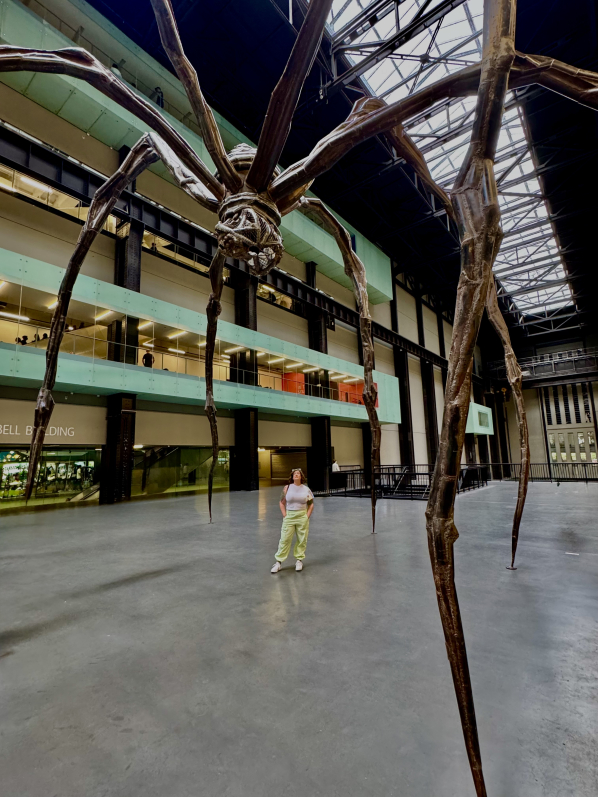
Photo of Melissa Stone under a huge spider sculpture