What does it mean a young child confidently calls something else by the entirely wrong word? What does it mean for a child to know that “moo” means cow? Well, for students in “Principles of Language” led by Dr. Lora Hawkins, answering that question requires more than simply correcting a child’s vocabulary. It means understanding the complex processes of the brain behind how children learn to communicate.
On November 2nd, I sat in on one class period to observe students in the Principles of Language course, who prepared for a run of the mill quiz to help test their skills and grasp of the English language. Instead they were met with a pleasant surprise. Instead of completing this assessment themselves they would be giving the assessment to the young children of the AppState English Departments Faculty and Staff. Observing the ways that language changes in the crucial years of development from ages one to four.
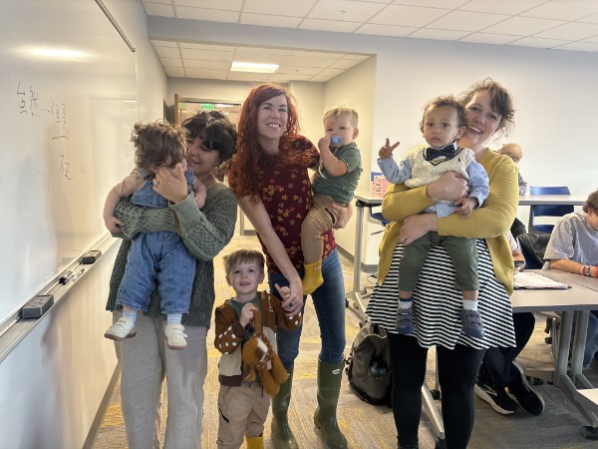
Led by Dr. Lora Hawkins, the class welcomed the young children of faculty and staff members, Andie Pabón Thomas, Dr. Peaches Hash, and Dr. Lora Hawkins, herself. Their children each span between the ages of one and four, giving students an opportunity to observe language development firsthand. Through the use of children’s books, building blocks, animal sounds, picture recognition, counting exercises, and congenial conversation, students had the opportunity to explore how exactly young children begin to associate sounds, words, patterns, and meaning.
The activities highlighted how language acquisition extends beyond the bounds of spoken vocabulary. Physical actions, music, repetition, and everyday routines all contribute heavily to a child’s growing understanding of communication. Even seemingly simple interactions, such as recognizing an animal or responding to a familiar phrase, demonstrate the foundations of language learning.
Students also considered how a child's environment helps them acquire language. Words and phrases frequently heard at home become familiar and useful building blocks for ways that children communicate. As children progress through these stages of development, their understanding goes from recognizing individual sounds and words to forming four to five word phrases.
For any aspiring teachers, comprehending these early stages is especially important. Recognizing that language develops through both interaction and experience allows future educators to better understand the differing ways that children can communicate. Even when a child doesn’t respond immediately, allowing space for response and encouraging participation remain essential parts of the learning process.
By placing students directly alongside young children, this experience offered an excellent opportunity to see the legible parts of language development. Putting all their studies into actualization by working with actual children. This allowed for language to take a new shape beyond grammatical rules, but as an evolving and ever-changing process shaped by the everyday experiences we encounter. Sometimes, understanding language means understanding what makes a child understand that “moo” in fact means cow.
Written by Joseph Spurlin
Faculty and staff holding their young children in a classroom after the Principles of Language class activity