Alex Sloop was not always the best student growing up. In fact, to be clear, he was a “D student” until high school. But come high school, something changed, and not just the creation of Vine. Through his amazing teacher, Mrs. Janet Ross, and the subjects she taught, which included World, American, and British Literature, Alex Sloop was a student born again. He also discovered the 1989 film “Dead Poets Society,” starring Robin Williams and Ethan Hawke, which inspired a generation to carpe diem–to chase artistic individuality in a world of conformity, which might be why he has life-sized cardboard cutouts of Danny Devito in his office.
Sloop has been obsessed with the film ever since and now, he gets to live the film out (well, the teaching part anyway; not the dying part, hopefully), as Sloop turned his ‘D’s in an ‘A’– M.A. specifically, a credential that helped him land his current gig as a lecturer in Writing, Rhetorics, and Technical Communication teaching courses like RC 1000 and RC 2001.
Sloop's main academic interest beyond teaching writing is Japanese Literature, in particular haikus and the writings of Matsuo Bashō, a Japanese poet from the Edo period whose work discusses themes of beauty in nature and the impermanence of life. Next semester, he will get to share that passion with students when he teaches a seminar on the Japanese philosophy of wabi-sabi, meditation, and haiku, HON 1515. Sloop will also present his latest scholarly work “Tasting Words: Linguistic Mouthfeel in Food Politics” in Japan in October 2026. I asked him to write a haiku in 60 seconds and he churned out one in less than 30, which you can read below, because Alex Sloop is the real deal.
EA: Would you rather be a horse in the sea or a shark in the sky?
AS: Never mind, I don't want to do this interview[laughs]. Okay, well, if I'm a shark in the sky, I assume I'm going to have to be victim to gravity, correct?
EA: It's up to you, really.
AS: Well, if I could fly, then a shark in the sky. Otherwise, a horse in the sea.
EA: Okay. That is completely fair.
EA: Alright, so you got your masters at App State, right?
AS: Yes.
EA: Has it been kind of weird teaching at App State after being a student?
AS: Honestly, no. So I was only a grad student here. I got my undergrad at UNC Asheville, and for half the time I was a grad student, I was teaching part-time anyway. As soon as I started teaching part-time, I was ready to do it full-time. I wanted to hurry up and get my master's. Because I love doing it. So, really, there was only about one year when I was at App when I wasn't teaching some classes. Even when I was a grad student, it felt more like I was a teacher than anything else.
EA: Nice.
EA: I've heard that you're a fan of haikus, is this true?
AS: I'm a huge fan of Haiku. I tell people I'm into Japanese literature, and they always ask me if I've read some of the more modern Japanese, um, authors and poets, but really I'm more into Edo period literature. So, my favorite Japanese author is Bashō. Yes, I'm definitely into haiku.
EA: Nice. If I were to give you 60 seconds, do you think you could write me a haiku?
AS: give me a topic, and yes.
EA: markers.
AS: Okay, you tell me when the timer…
EA: Yeah, let's go. Alright, the timer starts now.
…27 seconds later
AS: All right.
EA: Already?
AS: Yes.
EA: Can I hear it?
AS:
Erase and replace
to know what the marker does,
is to forget why.
EA: That is beautiful. Thank you very much.
EA: What is the most interesting thing about you that people may not know?
AS: I have a life-size cardboard cutout of Danny DeVito.
EA: That is amazing. That is very interesting.
AS: This is turning out to be the most chaotic interview I've done. I'm enjoying it.
EA: Yeah, that's kind of what we're going for, so… glad you like it.
AS: Something else a lot of folks know about me, or my students especially. I have a stuffed possum named Stinky that accompanies me to class. It started as a joke. Someone gifted me a possum stuffed animal whenever I got my full-time position, so I got my office, and I figured he'd just be an office decoration, and I started hiding him around the room in classes, and eventually he became, like, a class mascot, and my students named him Stinky one semester, and since then, he has to accompany me to class. He is in my profile picture, which is a little avatar that my partner made.
EA: That's amazing.
AS: And students have known me as the possum teacher ever since. I mean, I walk to my classes in Sanford with a stuffed possum tucked under my arm, because if I don't bring Stinky to class, the students get upset.
EA: That's fair.
AS: I love it. Everyone's a child at heart.
EA: So, what were you like as a student?
AS: When I was really young, I did not care for school at all, like, elementary, middle school. I was a straight D student. When I got to high school, I became more interested in the subjects I was learning and since then, I've considered myself a pretty good student. I always try to get readings done; I like to be social; I like to be compassionate with my peers and with my instructors. I like to get to know my instructors well.
I think that's part of the reason I was able to, sort of, get my foot in the door at App, by getting to know a lot of the folks in the English department, and I'm very fortunate for being able to land a full-time job right after getting my master's. I mean, that was a mix of getting to know people, doing the right thing, having perseverance, but also, honestly, luck. You know, just the right moment at the right time was when I graduated. And even now, I'm still technically a part-time student. Last semester, I started taking one class a semester towards an Appalachian Studies Master. Full-time instructors and staff get one free class a semester. I think it's 3 free classes a year. So I figured if I stay at App for another 5 years, I could get a free master's degree out of it. And if I end up leaving before then, well, I didn't have to pay anything, and also I got to take some amazing higher level classes Appalachian Studies. So even now, I try to get to know my instructors. Like my current instructor, Trevor, I have hung out and spent time with him well before I was a part-time student again. So, we went to DC last year to present. Social, I guess, is the short answer to that question of: what kind of student was I?
EA: If you had to teach a class outside of the English department, what would it be?
AS: I will actually be teaching a class outside of the English department next semester. So, speaking of pure luck, I was fortunate enough my first semester teaching full-time, I got to teach the honors sections of RC2001. I think it was just a technicality. The guy who was supposed to teach them had moved away, I think. At the last second, right around the time I got hired, so I just got them. Apparently, I made a good enough impression, so I was asked to teach the honors classes again later at a different time, and I got a good foot in with the Honors College, and I was invited to submit an application to teach a first-year honors seminar, and it just got approved. So, next semester, I will be teaching a class, actually, on the Japanese philosophy of wabi-sabi, meditation, and haiku, which I think is just a phenomenal philosophy to talk about with incoming freshmen, folks who are just coming to campus for the first time Wabi Sabi is all about embracing imperfection and impermanence and I think it is such a good contrast to the
perfectionism that we get hammered into our heads–the Western Enlightenment idea of rationalism we got hammered into our heads throughout high school. To be like, alright, now that you're in a new, strange place, you've got other things to consider, keep in mind, it's okay to make mistakes. It's okay to not finish things, and that's sort of what the philosophy is about.
EA: That's awesome. Congrats!
AS: Thank you.
EA: Can you tell me some about your presentation Tasting Words, Linguistic Mouthfeel in Food Politics?
AS: Yeah. Well, so that is a presentation that has not yet happened. I'm excited for it, but that's going to be in October. So a lot of the research is still developing. You know, the old adage of, undergraduate students get it done a week before, graduate students get it done a day before, whereas professors are working on their research on the way up to the podium.
So, it's a little bit of a development, but in undergrad, I studied mouthfeel in poetry, which is nothing new, that's a common thing. It's where the way you speak the words mimic the way that you are eating a specific object, or sort of subconsciously create sensory feelings in your mouth
that are evocative of specific themes. The word plum is perhaps the best example. It's a poem, and it has got a lot of repetition of that sound. And so, because of that, as you read the poem, if you were to read it out loud, you're mimicking eating a juicy plum. To peel a grapefruit is another great example. Persimmons by Lee Young Lee. Fantastic example. All of those are poems that are also examples of fruits. What mine is going to focus on is how we create mouthfeel in more of a pros setting, and not necessarily just to mimic, I'm reading persimmons by Lee Young Lee out loud, and it feels like I'm eating a persimmon. But rather to mimic conversations on food politics. So I'm going to focus on two different texts, both wildly different.
The first being George R.R. Martin's A Song of Ice and Fire series. In the books, there are amazing descriptions of food. And awful descriptions of food, so much so that the way he describes it does evoke mouthfeel. Like, when you're reading the good food, it feels amazing in your mouth. When you read bad food, it feels like the language he uses is almost as if you're eating something soft and you get a bite of something hard. And then, you know, you kind of cringe. But this comments on the food politics, because the really good, savory food is always upper class. The really cringey food, always lower class. And even when the upper class scenes have food that is less than savory, it still has the mouthfeel of something positive. Whereas, even when the lower class is eating something that really isn't that bad, it still has the mouthfeel of something disgusting.
So it's commenting on the politics of food insecurity, specifically in a medievalism context, but we have another great example in the Canard County Trilogy series by Robert Gipe, which is what I wrote my master's thesis on. All 3books that Robert Gipe wrote, “Trampoline,” “Weed Eater,” and “Pop” comment on food, and extractive industries in Appalachia sort of pushing sugary and processed foods while trying to negate traditional Appalachian cuisine. “Pop” comments on it the most of all 3, because that one specifically focused on the soda pop industry.
But they all comment on food. And Gipe does a very similar thing, but it's almost in reverse. The foods that are pushed on Appalachians feel good in the mouth because they're processed, they're sugary, they're addicting. But in “Pop” especially, you get the exact same sense of that good mouthfeel, but almost slightly different for all of the Appalachian, like, the traditional Appalachian cuisine as well. And it's sort of pushing this narrative of, if we were to switch back to traditional cuisine, it's not going to be satisfying like experiencing all these oatmeal cream pies from Little Debbie, and I'm forgetting all of the sugary processed foods, but you get what I'm saying. Does that make sense?
EA: Yeah, that's really interesting. Can you finish this sentence for me? Students should study English at App State because of blank. But don't give me, like, the cookie-cutter catalog copy answer.
AS: Okay, well, as someone who's been obsessed with the film “Dead Poets Society” since high school, any answer that I could give here, genuinely is going to be a little cookie-cutter and cliched. I'm gonna be a little cliched, I'm not gonna lie. Students should study English anywhere, because the study of the arts in general, art, music, literature, writing, etc., is really what we live for. You know, things like business and science, those are great, and you should study those, but the reason we study those things is so that we continue to pursue and enjoy love and romance and heart and all of that. So that's why people should study English. Period. And I'm not gonna lie, that quote is nearly verbatim from “Dead Poets Society.” But people should study English at App, because we have got an amazing roster of instructors here at App, in the English department. I loved the department at UNC Asheville, I'm really so glad that I got to go there, because they've also got an amazing roster of instructors. My only regret of not going to App for undergrad is I didn't get to meet all of the amazing instructors we have here. Like, I'm really close with Zach Vernon now, but I've never had a class with him, and I hate that I never got to have a class with Zach. The other reason students should consider studying English at App, really English in general, but especially at App, is that a lot of times, English degrees get shunned as, like, one of those, oh, what am I gonna do with this degrees? You know, you get an English degree, you're going to be an English teacher, and that's not the case at all.
EA: Yeah.
AS: Regarding majoring in English, I have known English majors to go on to be lawyers, to go on to be even one time a doctor. Obviously, that person had to get another degree after his English degree, but they've gone on to be lawyers, doctors, teachers, artists, and all entrepreneurs, all sorts of businesses, the degree is not near as limiting as people think it is. Editors, journalists, etc. The other thing about App specifically is that we address that concern, especially under our current department chair, Dr. Flores.
EA: Mm-hmm.
AS: Dr. Flores and a lot of the colleagues that have really shaped the English department around this idea of not just teaching English and not just teaching literature, but teaching the practicality of it. After you get your degree, where do you go from here? What sorts of jobs? And also, the English department here at App is super supportive. Whenever it comes to presenting at conferences, whenever it comes to networking I've never known a department more ready to prepare students for after they get their English degree, whether it's an undergraduate degree or a master's degree, and more willing to provide scholarships and funding for whatever you need in order to succeed after your degree.
EA: Thank you, very good answer.
EA: Okay, very serious question, do you believe that a songbird sings the song of its own life, or does it merely mirror the tune it yearns to follow?
AS: Why not both? I'd say that mirroring the tune that you yearn to follow is a part of the song of your own life anyway. If it's something that you yearn to follow, then why not let it be a part of your life, your dreams, the way you want to be is certainly a part of the decisions you make and the way you act. Now, I'm not a philosopher, but I do agree that there are original thoughts, there are original actions, there are original songs. But everything's influenced by something. So, why not both? Is that a cheating answer? Do I get a good grade for that?
EA: I think that's a beautiful answer.
AS: Oh, perfect, I'm gonna get a good grade in this interview, which is both something that is possible to attain and reasonable to want.
EA: Thank you so much for being a part of this very chaotic and sporadic interview.
AS: It has been a fantastic interview–probably one of the most fun interviews I've done, so I appreciate you.
EA: Let's go! I appreciate you.
Credits:
- Interview by Ethan Atwood
- Image & Text Credit: Alex Sloop via Instagram

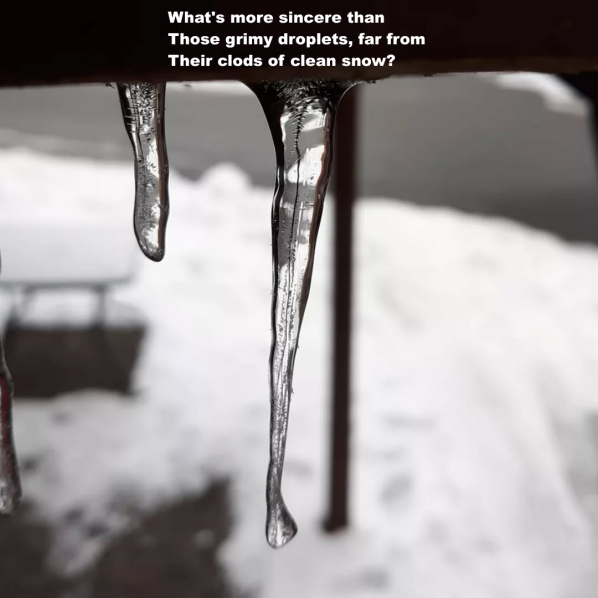
Photo of icicle melting with text: What's more sincere than Those grimy droplets, far from Their clods of clean snow?