By Ethan Atwood
Under a tent at Merlefest stood a lone bluegrass icon: Doc Watson. So beloved and revered (and maybe a little feared), no one would talk with him, let alone volunteer to come on stay and play with him.
“If nobody's gonna talk to me, somebody come play with me,” Watson cried out from the stage.
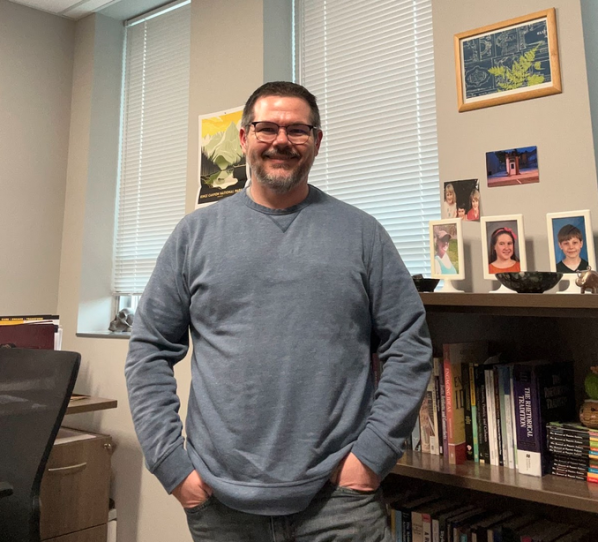
And so, 16-year-old Jacob Babb, now a little old and Assistant Chair in the English Department, headed Watson’s call. Whether it was adolescent audacity, compassion, or sheer ignorance as to who Watson was, Babb cannot be sure, but he mounted the stage and approached the bluegrass-god and played upright bass with him for two whole songs.
Although Babb doesn’t remember which songs, he will never forget the moment, in part because he’d only picked up the mandolin (a notoriously difficult instrument) just two years before. Since then, he’s grown into one of the meanest mandolin-pickin’ English teachers this side of the Mississippi.
But beyond his musical street cred, Dr. Babb also enjoys an impressive academic resume. Early in his career he wrote for several prestigious academic journals like Composition Studies, Writing Program Administration, Composition Forum, Kairos, and Harlot (for the laymen reading this, these are top-tier academic journals) and since, has authored several chapters featured in various books, among which his favorite is: “Toward More Sustainable Metaphors of Writing Program Administration”. Although this book may not be found on your average coffee table, it is also a big deal. As of late, Dr. Babb has evolved from the role of a writer into an editor and is currently the editor of Composition Studies.
When he isn’t editing academic journals or plucking away at the mandolin, Dr. Babb teaches a wide range of classes. His expansive course catalog ranges from undergraduate classes in technical writing and science fiction, to honors courses in folk horror, to graduate courses in composition theory and pedagogy. This is his fourth year teaching at App but his 22nd year as a professor.
Not many professors would help one write their own hit piece, but not many teachers are like Dr. Babb. He claims he’s not an “overly interesting person,” but behind his stellar academic resume, 4.9 star average on rate my professor, and toothy grin, is a comically ticklish-“Moby Dick”-despising-WCU superfan that nurses deep malice toward one particular songbird. Read to find out who, and see if these allegations are true, below.
Interview Transcript
EA: Who would win a pillow fight between you and the tickle monster?
JB: Wow, that is more whimsical than I was prepared for (says while giggling). The tickle monster would win, because I am outlandishly ticklish.
EA: I feel like if you were outlandishly ticklish, you would be really prepared. Like, you would just have a bunch of rocks on you, maybe, full armor.
JB: Yeah, that's true. If you know that you're going into that specific fight, you go in prepared for it, but if it was just a street battle that erupted in the middle of nowhere I would not win it, and I wouldn't want to survive it either. Tickling I hate, so just, just go ahead and put me down.
EA: Yeah. Oddly, I thought you were going to be a ticklish guy. So take that as you will. (Both laugh).
EA: You write for a journal, correct?
JB: Yeah, are you ready for the journey? So I currently edit at Composition Studies, but I also published at Composition Studies. I published in Writing Program Administration, Composition Forum, Kairos, and there's one that I'm not remembering(Harlot). Those are the ones I published in. In rhetoric and composition, that means some of the big dogs are still out there waiting for me. I have not published in College Composition and Communication, or College English, although ironically, I have edited College English, but I would like to publish in those, and they are sort of career highlight publications.
EA: Do you have a journal piece you've written that you're particularly proud of?
JB: That's a great question. Not a journal piece, but a book chapter that I'm very fond of that is in a book called “Toward More Sustainable Metaphors of Writing Program Administration,” which has to sound fascinating. In it, I use this metaphor of the rhizomatic spread of the forest, as a way of understanding how writing program administrators build and maintain relationships as part of their professional work. And I interviewed a few WPAs for that, and studied some. It's called the National Census of Writing Data, and the piece just came together really well. It's one that I've heard from readers that they have really liked as well.
EA: Do you tend to enjoy the editing or the writing process more?
JB: Definitely the editing. Something I've come to know about myself is that I am a better editor than I am a writer. I'm not a bad writer, but I prefer the editing process, by a lot. You know, in some ways, editing feels like teaching, and in some ways it absolutely does not feel like teaching, but the working with writers to make their texts better, that is the thing that's in common with the editing and the teaching, and I like that process a lot. Just guiding it to completion a nice, clean, polished text is a really satisfying process.
EA: If you had a user manual on one subject, what would it be?
JB: That's good. So I'm a mandolin player, and one of the things that I learned early on as a mandolin player is that the chop, which is the thing that we do as rhythm, is this very kind of specific percussive sound that you can produce, and it takes a while to learn how to do. It's silly, because it just makes a sound, but to get that right takes years, so maybe that.
EA: Do you have any English hot takes?
JB: I have attempted and failed to read Moby Dick three times, and I'm not going to attempt it ever again. Moby Dick is my white whale.
EA: I'm glad to hear that, because I agree.
JB: I can't wait until you publish that and all of my colleagues just come after me.
EA: That'll be the headline: “Jacob Bab hates Moby Dick.”
EA: Can you tell me a little bit about your academic history?
JB: I was a History Major in undergrad, and I studied primarily European history, but by the time I realized undergrad was coming to an end, I knew that history wasn't really the field I wanted to stay in. I had accidentally picked up a minor in English literature, and really preferred those classes. I preferred the writing I was doing, and preferred the analysis. It made much more sense to me. And so when it was time to apply for MA programs at the end of my undergrad, I applied for some History and some English, and I didn't get into any of the History, and I don't blame those programs. They made the right choice, but I got into all of the English programs, and I said, okay, so maybe this is actually right, this is the way for me to go. So I went for my English MA, studied mostly medieval literature, and then I taught as a non tenure track lecturer for three years, mostly teaching first year writing. And that led me to apply for PhD programs in rhetoric and story after that.
EA: Where did you receive your Bachelors from?
JB: Western Carolina. When I was an undergraduate at WCU, App State was WCU's primary rival. Although App State never knew that and didn't care deeply. But when some of my undergrad colleagues found out that I was doing some work here, they might have called me a traitor. Although that rivalry has been dead for years, it’s not in their hearts.
EA: Who do you cheer for when App State and WCU play one another?
JB: Not gonna lie, even though I know they're gonna lose. WCU.
EA: With the Moby Dick thing and this, I can definitely put out a hit piece on you.
JB: Haha, you got a lot on me.
EA: What subject did you despise the most?
JB: Well, you know, that first year in college, I earned a D+ in statistics, and I remain inordinately proud of that D+, because I was convinced I had failed that class. It is not statistics fault, it wasn't my professor's fault. It was me. I was not interested in being good at that. Yet ironically, now, in my role as a writing program administrator, I use statistics pretty often, and it's not scary anymore.
EA: How do you feel about the Z chart?
JB: Nope, don't care about it at all. I immediately felt a pang of panic when you asked me.
EA: What is the most interesting thing about you that people don't know?
JB: I don't know. I don't think I'm an overly interesting person. Usually the go to answer I would give is that I played with Doc Watson.
I went to Merlefest when I was 16. He was under a tent and everybody was terrified to talk to him, to play with him. And he got agitated and said “if nobody's gonna talk to me, somebody come play with me.” At the time I was primarily playing upright bass. I don’t remember what songs we played, but we played one or two songs together.
EA: What is the best water fountain in Sanford Hall?
JB: That is an important question. By sheer virtue of how often I use it is probably the one
on the second floor. I always just use the bottle filler. There was this brief period about a year ago where the water fountain on the third floor was just slightly just tinted brown, so we all avoided using that one.
EA: What is your Roman Empire?
JB: I'm not going to love that this is going to be my answer, but for the past year, it's been strength training. It's something that I've been trying to work on a lot.
EA: What’s your split?
JB: Push, pull, legs. I try to go six days a week
EA: Classic.
EA: Do you believe that a songbird sings the song of its life, or does it merely mirror the tune it yearns to follow?
JB: I’m gonna have you read that one more time(both are laughing) I bet everyone has you read that multiple times.
EA: No, typically they have the answer on lock, which is a little scary.
EA: Do you believe that a songbird sings the song of its life(giggles), or does it merely mirror the tune it yearns to follow?
JB: (Giggles) I think it depends on the day for the bird. Before I moved here, there was a bird, and this bird somehow got its sense time, all messed up. So for about a month, it would start singing loudly at about 2 A.M. and I wanted to murder that bird and finally, it either went away or it died. For the record, I did not kill the bird. But it made me aware of the bird's song in a way I hadn’t been before.
Photo of Jacob Babb