By Ethan Atwood
Daring, fun, raunchy, violent, and speculative. These are five words Alexander Brock uses to describe the Italian Novella, and after interviewing him, I realize that a few of these words could be used to describe Brock as well.
From among these descriptors, the most accurate to describe Brock is daring and it only takes a brief glance at his resume to come to this realization. For starters, Brock collects languages like a 19-year-old that loves indie music and collects vinyl records. He can speak English, French (his strongest language, having completed an entire master’s degree in it), Italian, Spanish, German, and Hindi. He can also read Latin, Ancient Greek, Sanskrit, and Pali. Not content with his already impressive linguistic aggregation, he’s currently learning Arabic. For Brock, these languages aren’t just theoretical. He’s traveled to over 50 countries, allowing him to experience his cultural studies and practice his beloved languages, firsthand.
After receiving his B.A. and Ph.D. in Comparative Literature from Princeton University, he studied for his M.A. in French literature at École Normale Supérieure in France. Following graduation, Brock worked at Archipelago Books, a nonprofit book publishing company in New York, for a year. That year made Brock realize how much he loved academia, and stirred within him a yearning to return to it. He left Archipelago Books, accepted various teaching positions— even teaching Composition and French at a New Jersey state prison—but eventually (and thankfully) found home turf at App State.
All of these accomplishments are impressive on their own, but they become infinitely more impressive when one learns that his childhood passion was not literature but mathematics, a field of study he devoted the same intellectual resources to, but from which he ultimately pivoted, due to developing an unexpected —and irresistable— attraction to literature and poetry.
Though daring certainly describes both Brock and his beloved Italian novella, he would argue that the novella is better described with the word violent, a word as far away from his personality as a “Dick and Jane” book is to a Stephen King novel, because in reality, Brock is an absolute sweetheart. When asked who he would joust in the English department, he picked the nicest person he could think of, in hopes that the joust would end in a draw. Brock’s gentle ways reflect his deep care for those around him.
Such care, paired with his natural daring and profound intellect, makes him a well rounded scholar, and a teacher that any student feels lucky to have. Read below to see if Alexander Brock shares any other similarities with the Italian Novella.
Transcript
EA: If you had a joust to one member of the English department, who would it be?
AB: I would joust my neighbor Hannah LeClair, because we're both incoming faculty. We both started this year, and she's very nice and gentle, so I feel like she would not hit me too hard.
EA: Who do you think would win?
AB: I think we’d both try to be nice and not hit each other. So it might end up in a draw.
EA:Is this your first teaching job?
AB: It's my first full time teaching job. I taught at Princeton as a graduate student, teaching courses there, I taught French language and I taught English literature. They had a program to volunteer to teach in New Jersey state prisons, so I also taught English composition and French language in New Jersey state prisons. I worked as an instructor at a couple of New York colleges, as a graduate student at Baruch College, serving a lot of first generation and immigrant students, and that was really cool. And I worked at Cooper Union as well, which is a school dedicated to art, architecture and engineering. And then, more recently, I taught English composition at the University of Alabama, Birmingham. My wife was down there, so I followed her for a year, and I was teaching the English department there.
EA: Nice. What was it like teaching in the New Jersey state prisons?
AB: It was difficult because the classroom had no resources. The students were not able to use the internet, and often there would be a lot going on in the prison that would make it difficult for the students to concentrate in class. The students had to apply to this program, so they're all dedicated students working to get a degree while inside. But there are a lot of obstacles to teaching, which made it a pedagogically difficult experience. On the one hand, it was very positive to interact with these motivated students who were there to work together for a degree which would really help them after they get out. It was also very eye opening in that I knew this theoretically, but really was a firsthand experience, of realizing that the vast majority of people I was teaching were young men who ended up in prison due to socioeconomic circumstances. They're coming from rough parts of New Jersey, and on the one hand for things that they personally did. On the other hand, clearly as a result of living in certain neighborhoods that provided a certain kind of structure in which crime is more likely to happen. So seeing the larger socioeconomic injustice that is at the base of our prison system.
EA: What's the biggest thing you've personally learned about yourself from each of the degrees you've received?
AB: Can I focus on one of the degrees?
EA: Yeah, go for it.
AB: The most difficult one was by far the PhD. And I think one of the things that was most difficult for me was that I completed it during covid. What I've learned about myself through this process is that I absolutely need to be part of an academic environment to be working productively. Some people were able to rock the covid years and be super productive at home doing everything that they're supposed to do. That was not me. I realized that it's sort of the interactions with my colleagues and taking part in conferences in person and having in person interactions that are extremely important to my ability to do research, but also my ability to stay focused on what I'm supposed to do and so kind of led me to prize the experience of being physically at a university in a way that I hadn't fully understood before.
EA: That's good. What would you say is the most interesting thing about you, apart from English and writing?
AB: I've traveled a lot. I think I've been to over 50 countries at this point, mainly during my master's years, because I was in France, and flights are really cheap to Europe, but also to Northern Africa and elsewhere. Traveling is one thing I really love doing as a way of experiencing cultures firsthand. I've traveled quite a lot to Asia and different parts of Africa and South America, Central America trying to experience as much of the world, but really experience it and interact with people from other cultures as much as I can. And I kind of view my literature classes as doing that in a sort of metaphorical form. I teach World Literature, so I travel through different parts of the world and experience those cultures. Don't get to talk to people, but do get to talk to authors.
EA: That's sweet. Do you speak any other languages?
AB: Yeah, it's a major part of what I do as someone who came out of a comparative literature program and also teaches world literature. In terms of speaking, my best for foreign language is French, because I did my Master's completely in French. But I also speak to functional degrees, Italian and Spanish and German and Hindi, and I read Latin and ancient Greek and Sanskrit and Pali, which is the language of the Buddhist texts. And I'm working on Arabic right now.
EA: That’s a respectable list right there.
EA: What would you say makes Alexander Brock, Alexander Brock?
AB: Maybe a combination of sincerity on the level of enthusiasm for things and interest in things, and a kind of respect for other people, and a strong ironic bent that's able to also take things not seriously and see the absurdity and humor in the human experience.
EA: That's good, right there.
EA: I've heard you're a fan of the Italian novella. Is this true?
AB: Yes.
EA: Can you describe it to me in five words?
AB: The Italian novella in five words. Give me a second. Part of the problem of knowing a lot of languages is I can imagine words, and actually not in English.
- Daring.
- Fun.
- Raunchy, definitely.
- Violent.
- Speculative.
EA: That’s a strong five.
EA: What is your favorite piece of medieval inspired media, like a book, show, movie,
AB: Henry Osawa Tanner is one of the great black American artists of the 20th century,
whose work I really love, and I try to see his work in museums as much as I can. He painted my favorite modern Annunciation, the scene of the angel Gabriel, announcing the divine birth to Mary. And this would be medieval, because the worship of Mary really gained steam in the Middle Ages. Mary is a figure from the New Testament, but the worship of Mary gains full power in 11th, 12th centuries, 13th centuries, and I absolutely love this painting that he did in 1898 just before the turn of the century. And I just love this vision of Mary, she's so innocent and kind of fragile, but full of wonder as well.
EA: That's a good sleeper pick right there. I was expecting Game of Thrones or something like that, and you pull that out. Good work!(Both laughing)
EA: Can you tell me about your article, Angels and Rogues?
AB: Yeah, a super fun article to write, also about Mary. A very different vision of Mary that I describe in the article. Basically, the article is interested in part in the sort of parodic ways that certain medieval writers received narratives about Mary and so I look at one novella from Boccaccio's Decameron major collection of novellas from around 1350, and I argue that it comedic, though not sacrilegious reworking of annunciation imagery. I'm arguing that Boccaccio is interested in parodying the Annunciation scene, and writes this novella in which not a virgin woman, but man, gets miraculously pregnant. Not actually pregnant, but he gets convinced that he's pregnant, as three of his friends cross his path and ask him, in this repetition of addresses asking if he's well or not, if he's feeling sick, and he becomes convinced that he's sick, and then the doctor comes and says, “Well, you're not just sick, you're actually pregnant.” So I’m arguing that this is actually a parodic rewriting of the Annunciation scene. And surprisingly no scholars have pointed this out before, but my article points to a lot of different parallels and similarities between how writers in the 14th and 13th centuries were describing Mary and how Boccaccio describes this miraculous pregnancy of this foolish man.
So that's one half of my article, then the other half of the article is arguing that another important part of this is looking at the connection between this novella and South Asian storytelling. Part of what my research is on, is the tradition of storytelling that arose, or kind of gained a certain convincing form in the Classical Period of South Asia. One of the languages I work with is Sanskrit.
I work a lot with the Panchatantra, which is a collection of fables and tales, so also in this article, I track the way that a certain tale that was in the Panchatantra gets transmitted across multiple languages. How it gets translated from Sanskrit to Persian to Arabic to Hebrew, and finally into Latin, and then arguing that Boccaccio was using either this Latin tale or an oral recounting of it to write this novella. So kind of the larger argument of the article is that this specific novella represents this crazy cultural syncretism between medieval Christianity and the reception of South Asian storytelling in order to think about what language does in a fundamentally new way. Language is not something that just convinces us of ideas. It's something that can affect us corporeally.
EA: That's good. Do you see yourself more as an angel or a rogue?
AB: Definitely rogue. But I think the important thing is that rogues can help people out too. It's important to maintain a certain level of mischief.
EA: Do you believe that the songbird sings the song of its life, or does it merely mirror the tune that it yearns to follow?
AB: Definitely mirrors the tune that it yearns to follow. I think I'm very pro mediatization. I don't think we typically have direct experiences of anything and am anti authenticity. So as a principle, I'd say that we can never sing the songs of our life. We can only do so indirectly in an attempt to capture something that is always going to be out of our grasp because we live in a mediated reality.d
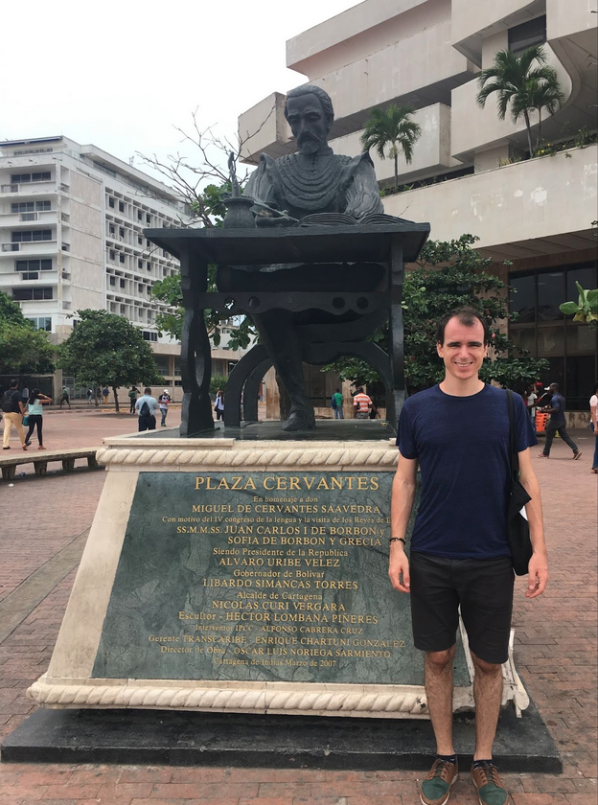
Photo of Alexander Brock at Plaza Cervantes